Agnostic guidance across the advertising value chain
The Ad Creative ID Framework (ACIF) from IAB Tech Lab establishes a standardized approach for identifying advertising creatives using a UniversalAdID attribute shared throughout the advertising ecosystem. Regardless of a company’s role in the value chain, successful ACIF adoption requires consistent understanding of how UniversalAdID is received, interpreted, stored, and shared across disparate systems and workflows.
We outline common responsibilities that apply to all participants, organized into two foundational scenarios every company should ask themselves; how do we receive UniversalAdIDs and how do we share UniversalAdIDs? Those answers provide the facts needed to align and drive our organization’s adoption. Regardless of your role in the value chain, If your systems or processes touch ad creatives, they touch UniversalAdID.
ACIF and Universal Ad ID adoption succeeds when organizations treat UniversalAdID not as something to “support someday,” but as a core creative element that must survive intake, transformation, delivery, and measurement without ambiguity.
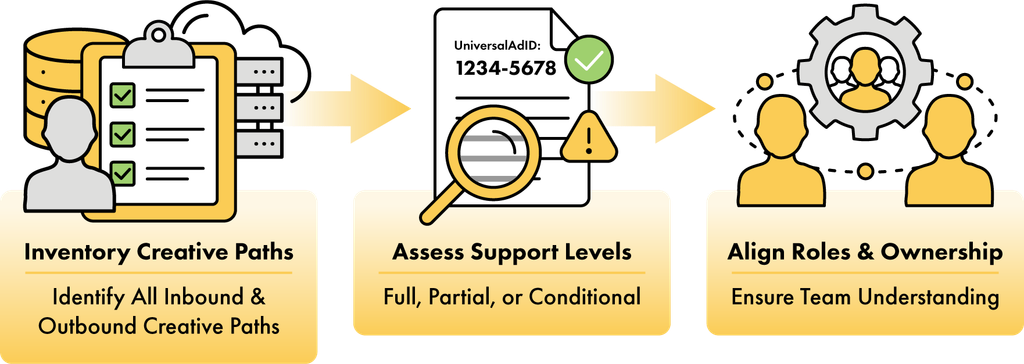
Scenario 1: How Do We Receive UniversalAdIDs?
Every organization receives creative details through multiple entry points. Your goal is to identify intake paths, determine your support levels so you can help drive awareness about them. A UniversalAdID that enters the organization but is misunderstood is effectively invisible.
First – Inventory All Creative Intake Paths
Organizations should identify every system, partner, or process that receives ad creative details. Intake paths differ by user, so start with the group that best describes your organization.
Some typical advertiser Intake paths include: (brands and agencies):
- Insertion Order workflows & campaign management systems
- Creative approval, clearance, or compliance tools
- Manual workflows such as emails, trafficking spreadsheets, or email-based submissions
- Measurement, verification, and reconciliation systems
Some typical ad tech or platform Intake paths include: (ad servers, DSPs, SSPs, CTV Platforms)
- Ad servers and traffic systems
- VAST Ad Tags
- DSP or SSP bid requests and responses
- CTV app ingestion pipelines
- Measurement, verification, and reconciliation systems
Each intake path should be evaluated independently.
Then – Determine UniversalAdID Support Levels
For each intake path, assess whether UniversalAdID is fully supported or partially/conditionally supported? Document the conditions and resulting outcomes, including where the identifier is lost, transformed, or ignored. Examples might include but not limited to:
| Fully Supported | Partial/Conditionally Supported |
|---|---|
| UniversalAdID is ingested, validated, stored and propagated unchanged | UniversalAdID accepted only if delivered in a specified field or object |
| UniversalAdID is available downstream for delivery, measurement, reporting and data exports | UniversalAdID stored but not passed downstream |
| UniversalAdID used only for reporting, not decisioning | |
| UniversalAdID overwritten or replaced by internal creative IDs |
Scenario 2: How Do We Share UniversalAdIDs?
Sharing UniversalAdID consistently is as critical as receiving it. Loss of the identifier downstream breaks cross-platform alignment and can dramatically reduce the operational benefits that come from these truly unique identifiers.
First – Inventory All Creative Distribution Paths
Organizations should identify every system, partner, or process where creative details are shared. This includes both external partners and internal consumers. Distribution paths also differ by persona, so start with the group that best describes your organization.
Some typical advertiser Distribution paths include: (brands and agencies)
- Cross-team internal handoffs (e.g. creative agency to media agency)
- Reporting, data exports, billing, and reconciliation feeds
- Measurement, verification, and attribution vendors
- Regulatory, compliance, or audit exports
Some typical ad tech or platform Distribution paths include: (ad servers, DSPs, SSPs, CTV Platforms)
- Outbound ad requests/responses
- Supply-side or demand-side integrations
- Reporting, data exports, billing, and reconciliation feeds
- Measurement, verification, and attribution vendors
- Regulatory, compliance, or audit exports
Then – Determine UniversalAdID Sharing Support Levels
For each sharing path, determine UniversalAdID support details. Document the conditions and downstream impact, especially where identifier continuity breaks. Examples might include but not limited to:
| Fully Supported | Partially/Conditionally Supported |
|---|---|
| UniversalAdID is transmitted intact and unmodified | UniversalAdID shared only with select partners |
| UniversalAdID remains associated with the creative across systems | UniversalAdID included only in reporting, not data exports |
| UniversalAdID suppressed for legacy integrations | |
| UniversalAdID mapped to internal IDs without external visibility |
Your Role: Align On Understanding and Ownership
Clear ownership prevents silent failures that surface only during audits, reconciliation, or live events. Organizations should clarify roles and responsibilities to ensure relevant teams understand:
- When UniversalAdID must be shared versus when it is optional
- Which teams are responsible for enabling or disabling propagation
- How partner requirements differ across platforms, regions, or media types
- How to respond when partners request UniversalAdId(ACIF) compliance validation
UniversalAdId adoption is not purely technical. Organizations must also ensure business processes similar to:
- Engineering, operations, ad ops, and compliance teams sharing a consistent understanding of UniversalAdID handling
- All teams knowing when UniversalAdID is required, optional, or ignored
- Clear ownership awareness for:
- troubleshooting missing or invalid IDs
- partner escalation
- internal documentation and training

Brad Pipkin
Director of Product, Advanced Televsion
IAB Tech Lab