Agentic advertising. It’s the buzzy topic everyone’s talking about, but what makes it not just a gimmick?
I believe agentic advertising exists to solve a specific problem: for each brief, an advertiser has likely millions of options for allocating their budget. Too many options for any buyer to individually evaluate and too many for any seller to stand out in. Agentic advertising offers buyers a way to evaluate far more options while still weighing how well each one fits the brief.
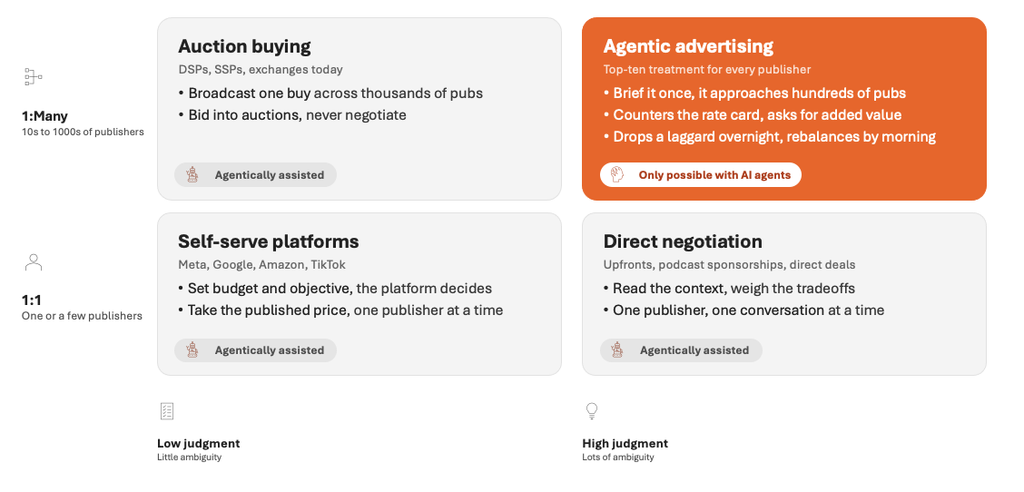
When I started my career as a media buyer, almost everything was manual: I would weigh publisher proposals against my brief, negotiate price, and engage over email and phone calls with one publisher at a time, especially those who would take me out to lunch after :). As the pressure to find more options grew, technology enabled me to do this at scale, but with less of my own judgment.
Media buyers today are only able to manage this scale by logging into a dozen different, fragmented interfaces, each with its own proprietary workflows. This has caused UI fatigue and left buyers to naturally fall back on what’s manageable: the two or three platform interfaces they know by heart, past performance heuristics, and existing relationships. The result is that options that would have been more effective for a given brief never get considered because the administrative cost to access them is too high.
On the sell side, that same dynamic means getting considered depends on having someone in the room. A publisher can be exactly right for a brief and never make the list because nobody there had the relationship or the headcount. The dollars go to whomever was already familiar rather than whomever fit best.
Agentic advertising creates an opportunity to apply high judgment across thousands of options at once. With more options evaluated, buyers can build a more effective media plans. Agents can compare publishers and proposals, negotiate with many of them in parallel, and recommend adjustments mid-flight.
The quality of agentic decisions depends on the information available and how clearly the buyer has defined their objectives and constraints.
For this to work across the industry, agents need a shared way to understand what a publisher is offering, communicate a buyer’s requirements, and establish what they are authorized to do. Without common standards, we risk recreating the same fragmented workflows and complexity that exists today. This is where IAB Tech Lab has a role: bringing buyers, sellers, and technology providers together to build the shared foundation that lets their agents work with one another.
I joined IAB Tech Lab as Head of Agentic Technologies to help make this possible. I want buyers to be able to act on the best opportunities for their brief, and sellers to compete on how well they meet it. Getting there will take buyers, sellers, and technology providers working together on standards that hold up in real campaigns.
If you’re building or testing agentic advertising, I want to hear what’s working, what’s missing, and where we can help.

Matthew Jacobs
Head of Agentic Technologies
IAB Tech Lab