The biggest mistake the advertising industry could make with AI agents is treating them like another slideware standards exercise. That is why the AAMP (Agentic Advertising Management Protocols) framework includes actual Buyer and Seller Agent SDKs — not just specifications, diagrams, or aspirational architecture documents.
AAMP is opinionated by design: if the industry wants interoperable agentic advertising, the ecosystem needs working code, reference implementations, executable workflows, and operational primitives that companies can deploy, fork, test, audit, and improve immediately. The decision to release real SDKs is not a convenience feature. It is the strategy.
Production-Ready Interoperability that Eliminates Friction
The history of advertising technology has repeatedly shown that standards alone do not create interoperability. Shared implementation patterns do. Specifications without executable examples inevitably fragment into incompatible interpretations. Every company claims compliance while implementing its own dialect. The result is operational friction, integration delays, and ecosystem mistrust.
AAMP takes the opposite approach, as the Buyer Agent and Seller Agent SDKs in AAMP 2.0 establish a common operational baseline for agentic transactions. They demonstrate how agents discover each other, negotiate, exchange signals, manage identity and trust, execute workflows, and complete transactions using existing Tech Lab standards such as OpenDirect, Deals API, AdCOM, OpenRTB, and sellers.json.
That matters enormously, because the industry is not struggling with a lack of ideas about AI agents. The industry is struggling with execution consistency. Everyone can say they are testing or implementing an “AI-powered media buying workflow.” Very few organizations can operationalize one in a way that is interoperable, auditable, governable, and compatible with the broader ecosystem.
The AAMP SDKs close that gap. Instead of forcing every DSP, SSP, publisher, retailer, broadcaster, agency, and adtech vendor to invent agent orchestration independently, Tech Lab provides production-ready starting points so that ecosystem participants can adapt to their own environments. This is a critical distinction.
The SDKs are not rigid products. They are adaptable frameworks. From a standardized starting point, companies can extend negotiation logic, integrate proprietary forecasting systems, swap identity models, customize pricing engines, connect internal workflows, or implement vertical-specific optimizations — while still remaining aligned to common interoperability patterns. That’s how ecosystems built on open standards succeed: shared foundations with differentiated innovation layered on top.
The alternative is no fun at all. Without shared SDKs, every agent platform would create its own discovery model, negotiation protocol, transaction workflow, event structure, approval framework, and trust system. The ecosystem would quickly become a landscape of isolated agents, unable to easily communicate.
AAMP’s SDKs prevent this by establishing executable common ground. While surface-level demos may look simple, once you dig into what they include, you find that they support the real operational complexity required for enterprise-grade advertising workflows.
The Buyer Agent SDK already supports multi-seller discovery, campaign orchestration, budget allocation, negotiation strategies, approval workflows, and booking flows, while the Seller Agent SDK includes tiered media kits, pricing engines, negotiation management, SSP integrations, trust verification, identity-aware access control, order lifecycle management, and event-driven architecture.
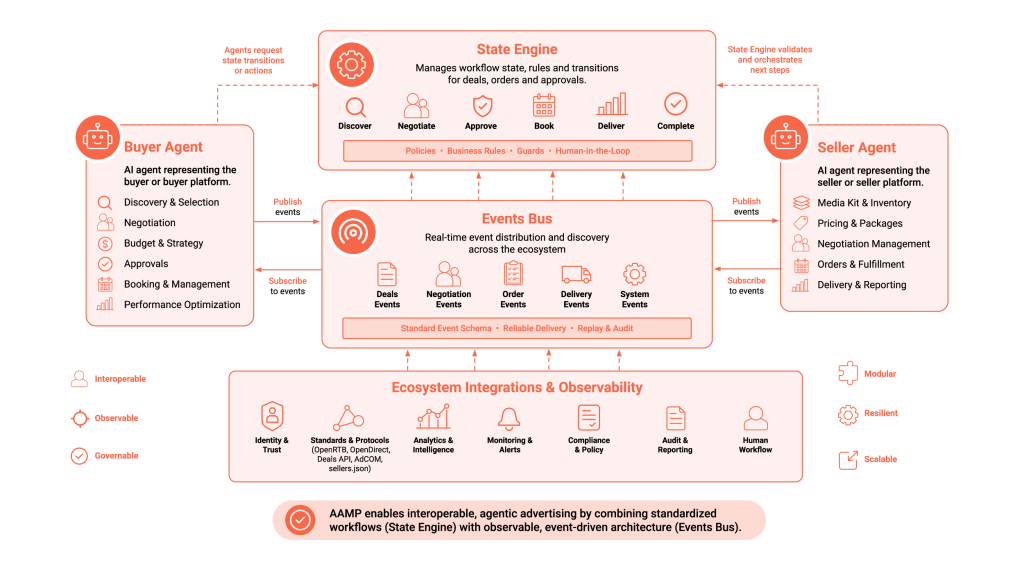
Taken together, usage and testing move the industry conversation away from theory and into operational reality. That operational reality depends heavily on two foundational core architectural decisions that were built inside AAMP: the Events Bus and the State Engine. These are not implementation details. They are the backbone of trustworthy agentic advertising.
Bringing Transparency to the Opaque
The Events Bus matters because agentic systems cannot function as opaque black boxes.
Advertising workflows involve approvals, negotiations, inventory changes, pricing adjustments, delivery updates, compliance checks, cancellations, revisions, and transaction state transitions across multiple independent participants. In a world of autonomous or semi-autonomous agents, observability becomes non-negotiable.
The AAMP Events Bus creates a standardized operational nervous system for the ecosystem. It enables systems to publish and react to state changes consistently across workflows and organizations. This creates three huge benefits:
- Transparency: Every action becomes observable and traceable. Buyers, sellers, platforms, auditors, and governance systems can understand what occurred, when it occurred, and why it occurred.
- Extensibility: An event-driven architecture allows companies to attach their own services, analytics, governance controls, optimization engines, compliance systems, notification frameworks, or human review layers without rewriting core workflows.
- Resilience: Modern distributed systems cannot rely on brittle point-to-point orchestration. Events decouple services and create scalable, fault-tolerant operational models that are far better suited for AI-native infrastructure.
Ultimately, the Events Bus creates accountability. The industry is rightly skeptical of autonomous systems making transactional decisions without visibility or governance. But a standardized event architecture provides the auditability required for trust in agentic transactions.
And what’s a State Machine?
While it may sometimes feel like it, AI agents are not magic. They are workflow participants operating inside structured business processes. This means they require explicit lifecycle management. This is handled by the State Machine in the AAMP SDKs.
Advertising transactions still require explicit lifecycle management. Deals move from draft, to negotiation, to approval, to booking, to delivery, to completion. Orders change state. Permissions evolve. Human intervention occurs. Exceptions arise. Contracts require governance. The State Machine is a fundamentally important design philosophy that ensures those workflows remain deterministic, governable, and interoperable.
AAMP does not assume AI replaces process discipline. It assumes AI accelerates process execution inside well-defined operational boundaries. This is a model that encourages enterprise adoption.
Having a State Machine governing the AAMP architecture creates consistency across participants by enforcing structured transitions, approval gates, and lifecycle rules. It allows automation without surrendering control, enabling human-in-the-loop governance where necessary while continuing to support autonomous execution where it makes sense.
This is what makes agentic advertising viable at scale. It’s not a flashy demo with little substance, or the addition of an AI narrative to your pitch deck. It’s about having the same operational reliability with agents as you do without them.
Why the SDK Strategy Matters
The industry does not need another conceptual framework for AI agents. It needs interoperable infrastructure the ecosystem can actually deploy.
By releasing adaptable Buyer and Seller Agent SDKs, coupled with foundational primitives like the Events Bus and State Machine, IAB Tech Lab is doing something new in standards development: it is giving the market executable architecture instead of abstract aspiration.
That dramatically accelerates adoption, lowers implementation costs, reduces fragmentation, creates faster ecosystem learning cycles, and enables real-world experimentation.
Above all this approach gives the industry a chance to build an agentic future that remains open, interoperable, governable, and standards-based, before proprietary silos have a chance to define the market by default. Join the Agentic Task Force today and help build the standards-based agentic future together.

Aidan Cardella
Architect, AAMP
IAB Tech Lab