The infrastructure underpinning digital advertising is undergoing a quiet but consequential transformation. As browser restrictions tighten, third-party cookies recede, and data privacy expectations intensify, publishers and advertisers are increasingly turning to server-side architectures to future-proof their operations.
Adoption is accelerating rapidly among publishers and advertisers of all sizes, and the question for most organizations is no longer whether to migrate, but how to do so effectively. Let’s examine why.
Why is server-side becoming the default architecture?
More and more organizations are moving their data operations server-side. Today, our team estimates adoption is about 30-40% across the top 1,000 websites, depending on the country (internal study conducted by Addingwell), and our data privacy benchmark shows a steady increase in server-side requests over the past year alone.
At its core, a server-side setup routes data through your own infrastructure before it reaches third-party vendors, rather than firing tags and pixels directly from the user’s browser.
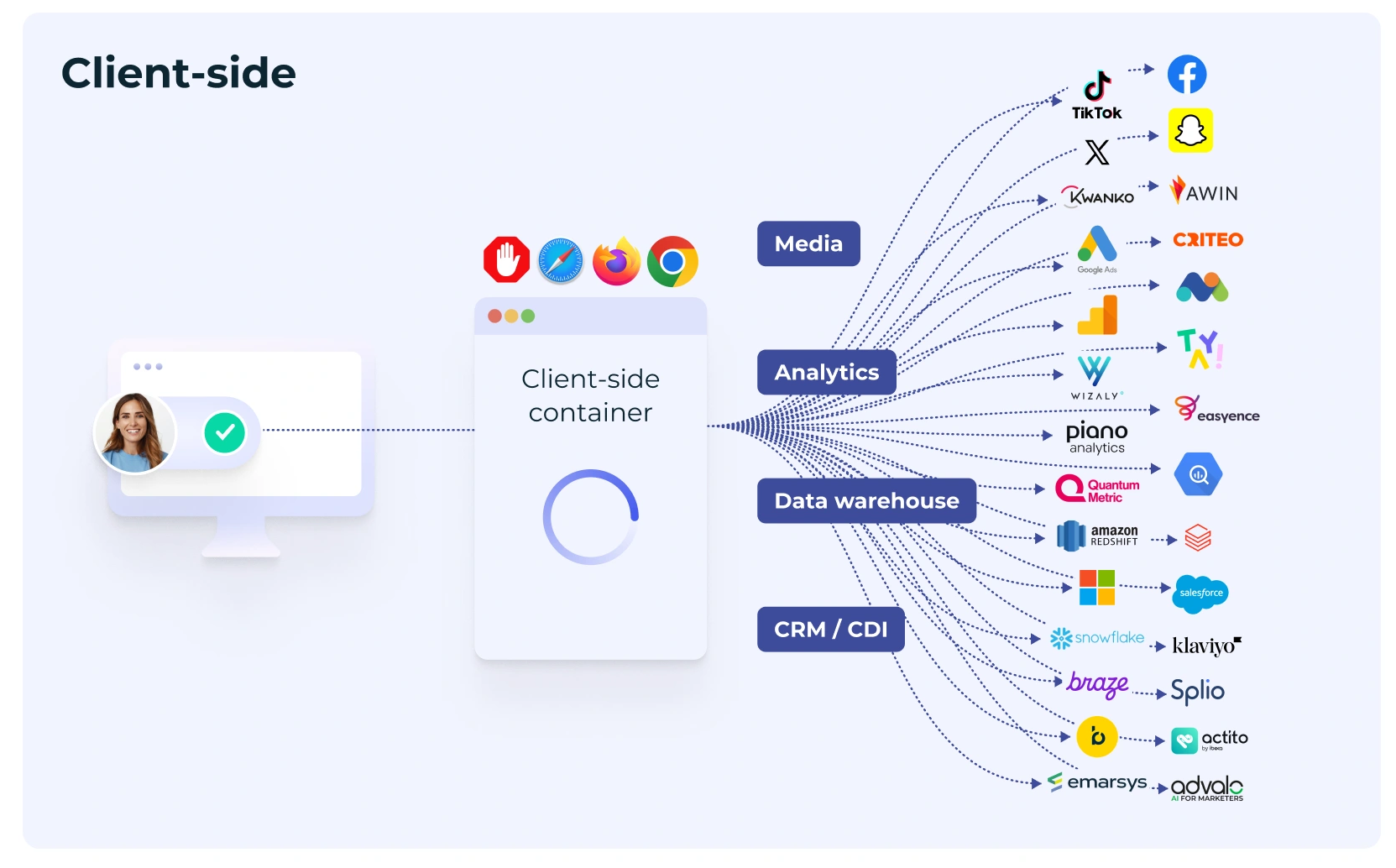
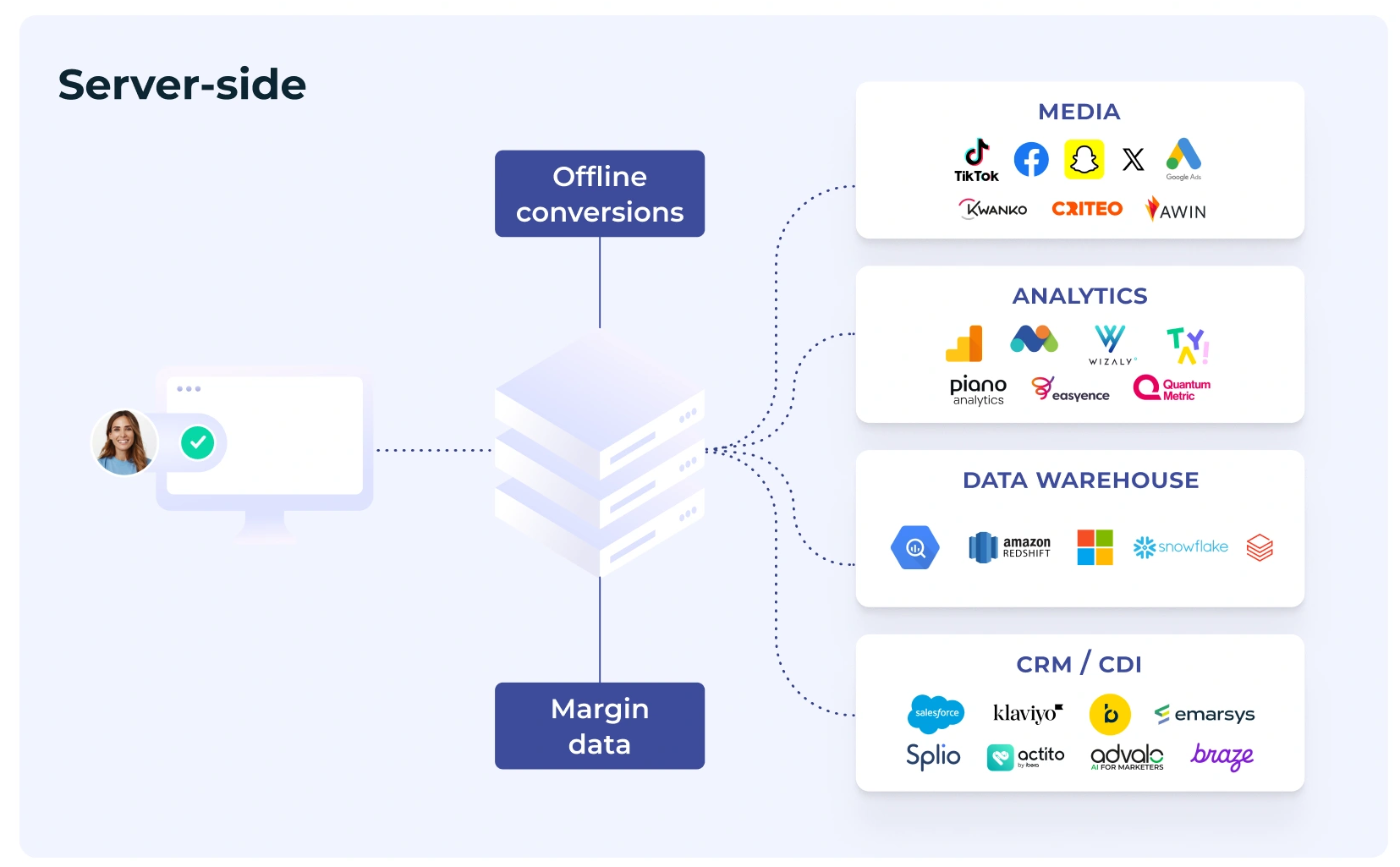
That shift in where processing happens unlocks a range of structural advantages:
1. Greater control over data and tracking
When data flows through your own servers, you decide what gets collected, transformed, and shared, and with whom. This gives organizations a level of pipeline visibility that client-side implementations simply cannot match.
2. Resilience to browser restrictions and ad blockers
Client-side tracking has become increasingly fragile. Safari’s ITP, Firefox’s Enhanced Tracking Protection, and the proliferation of ad blockers all erode signal quality at the browser level. Server-side architectures largely sidestep these limitations, delivering more consistent and reliable data collection regardless of the user’s browser environment.
3. Improved website performance
Offloading tag execution from the browser reduces page load times and JavaScript bloat, a meaningful benefit for both user experience and Core Web Vitals scores that influence search rankings.
4. Higher data quality
Fewer dropped signals and reduced sampling mean cleaner, more complete datasets for analytics, attribution, and optimization.
5. Enhanced privacy compliance
Because data passes through a controlled intermediary before reaching vendors, organizations are better positioned to enforce data governance policies (including consent signals) at the infrastructure level rather than relying on vendor self-compliance. This makes server-side a natural fit for organizations navigating GDPR, CCPA, and the evolving global privacy landscape.
The real-world challenges of server-side migration
Server-side is not a plug-and-play solution. It demands meaningful investment in technical infrastructure, and several challenges are worth understanding before committing to a migration:
- Infrastructure overhead. Maintaining and scaling a server environment introduces operational complexity and cost that client-side setups don’t require.
- First-visit latency. Consent status is unknown on a user’s first visit, meaning CMP JavaScript must still load before personalized ads can be served, a handoff that needs careful optimization.
- Signal integrity. Consent strings and other signals can be tampered with or ignored by downstream partners without robust verification mechanisms.
- Auditability gaps. There is no standardized logging across the data chain today, making it difficult to demonstrate to regulators exactly which vendors accessed data, and when.
These challenges are not insurmountable, but they do require deliberate architectural choices rather than a lift-and-shift migration approach.
What a future-ready server-side architecture looks like
Addressing the challenges we identified above requires thinking beyond the migration itself and designing for reliability, flexibility, and governance from the ground up. A robust server-side implementation should allow your organization to:
- Own your data pipeline end-to-end. Your server-side layer should act as a true intermediary, transforming, enriching, and routing data under your control before it reaches any third-party vendor.
- Decouple data collection from vendor dependencies. A well-architected setup means you can swap, add, or remove vendors without re-instrumenting your tracking, a major operational advantage as the vendor landscape evolves.
- Maintain signal quality across the full chain. From first-party identifiers to contextual signals, the architecture should preserve data fidelity end-to-end, ensuring what you collect is what your partners actually act on.
- Enforce consent and privacy requirements at the infrastructure level. Rather than relying on downstream vendor self-compliance, a mature server-side setup validates and enforces consent signals before data is shared, making compliance a structural property of the pipeline rather than an afterthought.
- Build for auditability. Logging data flows and access events is becoming a regulatory expectation. The ability to demonstrate what data was shared, with whom, and under what conditions is a competitive advantage as scrutiny intensifies.
Industry initiatives like the IAB Tech Lab’s Trusted Server are helping to standardize approaches to these challenges, providing a framework that balances performance with compliance.
At Didomi, our work on the Trusted Server initiative and our acquisition of the server-side tagging solution Addingwell last year reflect our belief that server-side, when done right, is an architecture in which performance and governance can reinforce each other.
The strategic case for moving now
The organizations that will be best positioned in the next three to five years are those building data infrastructure today that doesn’t depend on third-party browser mechanisms, isn’t vulnerable to platform policy changes, and can demonstrate compliance to regulators without scrambling.
Server-side architecture, implemented thoughtfully, delivers on all three. The migration requires investment (in technology, expertise, and the right partners), but the structural advantages compound over time. For publishers and advertisers serious about data quality, operational resilience, and long-term performance, server-side is becoming a baseline requirement.

Jeff Wheeler
VP of Product
Didomi