In programmatic advertising, it is easy to focus on the trees: a deal ID, a buyer seat, a platform UI, a status code, a pause request, an approval step.
Each matters. But the larger issue is the forest: programmatic deal management still depends on too many disconnected workflows across too many systems.
The industry has built sophisticated infrastructure for buying, selling, targeting, and measurement. Yet the operational layer connecting buyers, sellers, DSPs, SSPs, agencies, and platforms remains fragmented. Too much work still happens through manual handoffs, proprietary interfaces, duplicated data entry, and inconsistent status logic.
Agentic AI can help, but only if it is built on the right foundation.
The opportunity is not to add another layer of isolated assistants. The opportunity is to create standards-based, governed, interoperable workflows that agents can execute safely across the ecosystem.
A Practical Reference Implementation
As a contribution to the IAB Tech Lab’s AAMP (Agentic Advertising Management Protocols) initiative driven by the Agentic Task Force, HyperMindZ has donated an MCP server reference implementation for the IAB Tech Lab Deals API v1.0.
The implementation allows AI agents to drive the full programmatic-deal lifecycle against the spec’s data model: create, send to provider, confirm, pause, resume, and audit.
It exposes the workflow through ten MCP tools, includes a Mock Provider so it can run end-to-end without live DSP or SSP credentials, and provides a clean extension point for adding real platform integrations.
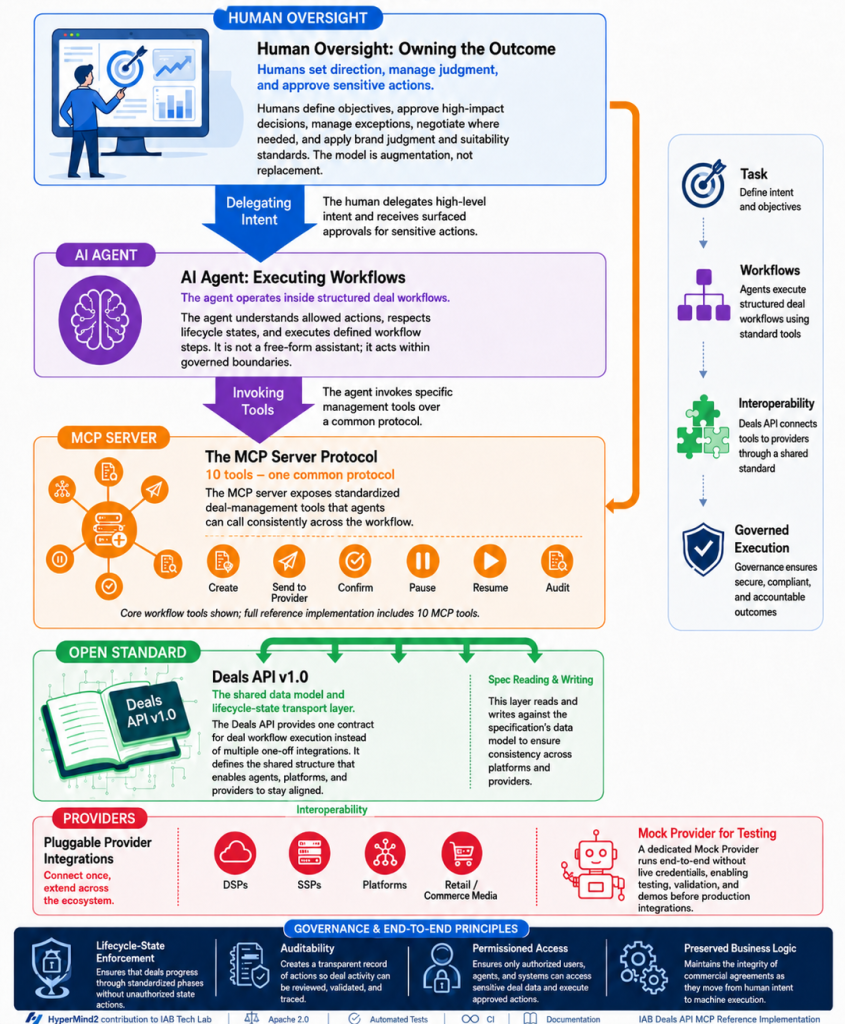
Figure 1: How the IAB Tech Lab Deals API MCP framework makes open standards agent-accessible while preserving human oversight, governance, interoperability, and provider flexibility.
That matters because this is not simply a demo of AI taking action. It is a working example of how an existing industry standard can become agent-accessible through a common protocol.
From Tasks to Workflows
The trees are the individual actions: create, send, confirm, pause, resume, audit.
The forest is the operating model behind them.
For agentic AI to create durable value in advertising, it needs to operate inside structured workflows. It must understand allowed actions, respect lifecycle states, preserve auditability, support permissioned access, and connect through shared standards rather than one-off integrations.
Without that foundation, agentic AI risks becoming another fragmented layer: every platform with its own assistant, logic, rules, and integration model.
That may create short-term convenience. It will not solve the ecosystem problem.
Interoperability is the bigger prize.
Why It Matters
For advertisers and agencies, standards-based agentic workflows can reduce operational drag: fewer manual status checks, fewer copied deal terms, fewer email chains, and faster movement from strategy to execution.
For publishers and media owners, they create a more scalable way to expose inventory, manage deal terms, support buyer access, and preserve commercial control.
For DSPs, SSPs, and platforms, they offer a path toward agent-accessible systems without sacrificing governance, permissions, or business logic.
For retail and commerce media networks, the need is even sharper. These environments combine audience rules, inventory controls, measurement requirements, brand constraints, and buyer-specific workflows. Agentic systems will only scale here if they are structured, auditable, and interoperable.
The broader lesson is clear: standards needed for agents to become useful enterprise infrastructure already exist.
Human Oversight Still Matters
Standards-based agentic workflows do not replace people. They reduce the repetitive work around people.
Strategy, negotiation, brand judgment, commercial decisions, and relationship management remain human responsibilities. Agents can help execute defined workflows. Humans should still set objectives, approve sensitive actions, manage exceptions, and own outcomes.
That is the right framing for enterprise adoption: not human replacement, but workflow augmentation.
Why the Handoff Matters
This contribution provides the industry with a concrete starting point: a working MCP server, Mock Provider, automated tests, CI support, documentation, contribution guidance, release notes, and an Apache-2.0 license to adopt, improve and innovate.
That moves the conversation from theory to implementation.
The next questions are practical: when to make the repository public, and who will maintain it going forward. Those are the right questions because they shift the work from demonstration to community stewardship.
Standards need more than specifications. They need working examples, implementation paths, feedback loops, and maintainers.

Dinesh Bhat
Co-Founder and CTO
HyperMindZ
Peter Ilberg
Head of Business Development & Strategic Partnerships
HyperMindZ