This piece was adapted from CEO Anthony Katsur’s keynote at the SOLD OUT IAB Tech Lab Summit 2026: Welcome to the Agentic Web. There was such interest, that we decided to release this perspective on the evolution of AI in advertising and what it means for the future.
AI in advertising is typically framed as a recent development, but that’s just wrong. It’s been a part of digital advertising since its very early days. Because AI is much more than just the generative tools that emerged in late 2022.
Every time someone opens a weather app or loads a news article, a remarkable chain of events unfolds in the background. Somewhere between the moment a page request leaves a browser and the moment an ad renders, an AI system evaluates a user, assesses context, generates a price, and executes a transaction. All in roughly 400 milliseconds.
That process is the product of approximately seventy years of artificial intelligence research, quietly compressing itself into a decision that most people never notice. This research can be broken down into three eras that can be considered “history,” and the one we are entering right now!
The Logic Era: Rules as Intelligence
Alan Turing published “Computing Machinery and Intelligence” in 1950 and reframed the central question of artificial intelligence. Instead of asking if machines could think, which is a philosophically unwieldy problem, Turing asked whether they could behave in a manner that was indistinguishable from a thinking person.
Six years later, at the Dartmouth Workshop, John McCarthy coined the term “artificial intelligence” and expressed confidence that meaningful progress was achievable within a single summer. That was a little ambitious, given the actual timeline proved to be closer to seventy years, but the Dartmouth effort did produce AI’s first functional milestone: the symbolic system.
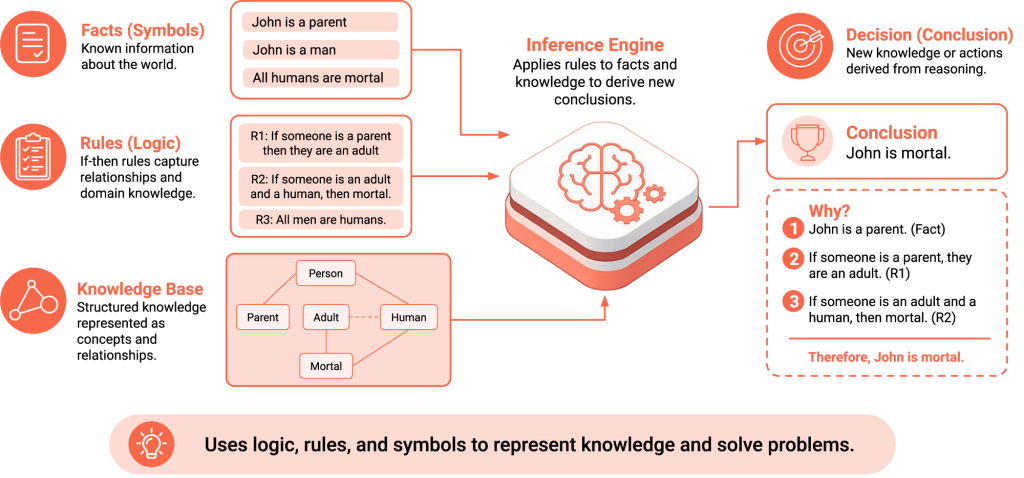
In essence, a symbolic system is an elaborate conditional logic tree. For example, if the patient has a fever and a cough, proceed to question B. If question B yields a positive result, recommend test C.
No learning occurs; no statistics are computed. In this model the intelligence is the accumulation of human-written rules, with a programmer and a domain expert sitting together and encoding that expertise as code.
For limited and well-defined domains, such as playing chess, symbolic systems performed reasonably well. The problem is that these systems are very brittle. As soon as conditions changed, every rule had to be rewritten by hand. When the first AI winter arrived in the mid-1970s, it was largely because symbolic systems could not survive contact with the complexity of the real world.
The 1980s brought a narrower refinement in the form of expert systems. Instead of attempting to encode general intelligence, these systems captured the specific decision rules of individual domain experts and were a genuine industry for a time.
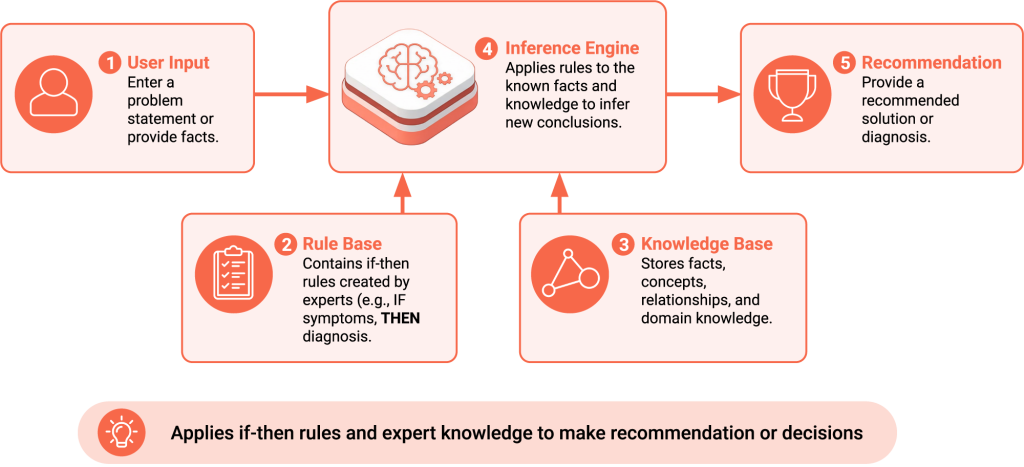
But they collapsed in a second AI winter by the late 1980s for the same structural reason of brittleness, which was compounded by the economics of specialized hardware becoming rapidly obsolete as general-purpose computing improved.
Out of the second AI winter came a fundamental shift in philosophy. Instead of writing rules, researchers began feeding computers large collections of labeled examples and allowing the systems to identify patterns independently. The spam filter did not require a programmer to enumerate every characteristic of unwanted email; it required a million emails labeled “spam” or “not spam.” The system would derive the rules itself. Machine learning was here.
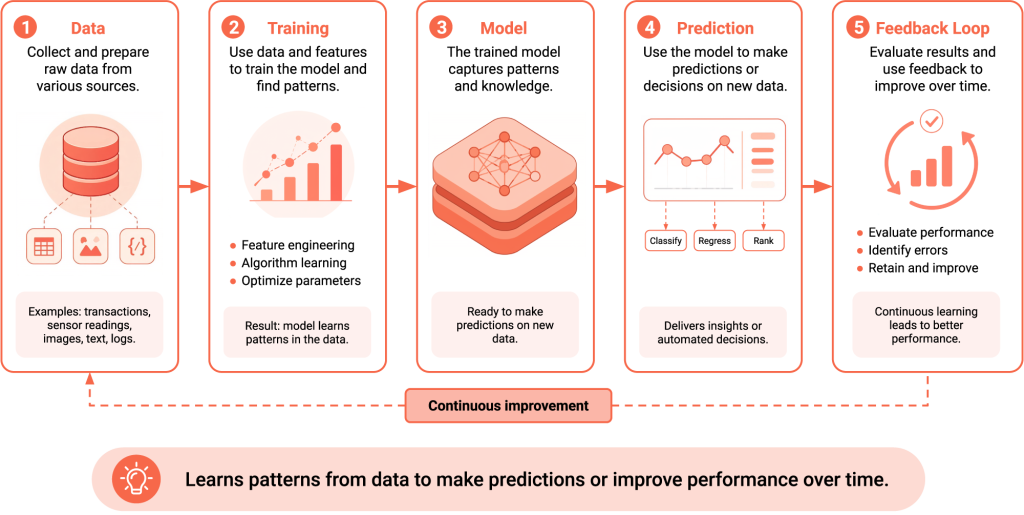
Fueled by cheap compute, cheap storage, and the growth of the internet, and provided with the necessary ingredients: data at industrial scale, the infrastructure to process it, and economic incentives large enough to fund serious engineering, machine learning changed everything.
By the late 1990s, it was running in production across consumer-scale systems: search ranking at Google, product recommendations at Amazon, spam filtering at Gmail, and ad auction ranking at Yahoo. None of this was marketed as “AI.” It was simply software that improved with use.
The workhorse techniques of this period were all variations on a single underlying idea: supply labeled examples, fit a model to those examples, and use that model to predict the next case. It turned out that advertising was nearly ideal terrain for machine learning. The data was abundant, with trillions of impressions, clicks, and conversions, each labeled with outcomes and feeding the machine. It’s such ideal terrain that machine learning remains at the foundation of the production ad stack today. But to reach the next era the machines had to gain additional understanding.
The Predictive Era: Transforming the Data
That understanding arrived in 2012, when Alex Krizhevsky, Ilya Sutskever, and Geoffrey Hinton at the University of Toronto, used a neural network to win the ImageNet image recognition competition by a margin so large that the field reorganized itself around the result within 18 months. Two enabling factors made neural networks newly viable: GPU hardware originally designed for video games proved mathematically well-suited to neural network computation, and the ImageNet dataset of more than 14 million labeled images assembled by Fei-Fei Li and her team at Stanford. Until now neural networks were mostly theoretical since they lacked the necessary data, storage, and compute power. Now they had all three.
Despite the biological framing, neural networks are really a form of applied mathematics. They are made up of layers of simple arithmetic, where the system assigns a “weight” or level of importance to every piece of information it sees.
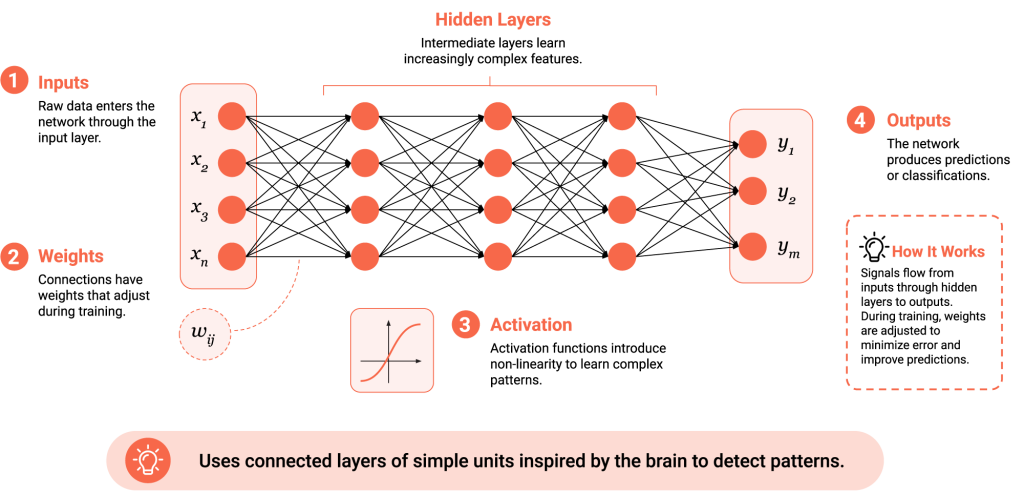
By adjusting these billions of weights, the system refines its math until it can reliably turn an input (like a consumer’s browsing history) into a highly accurate predictive output (like a personalized product recommendation).
What makes it special is that nobody tells the network what to pay attention to. Once it is given enough examples, it gradually adjusts the dials inside itself until its answers line up with the right answers.
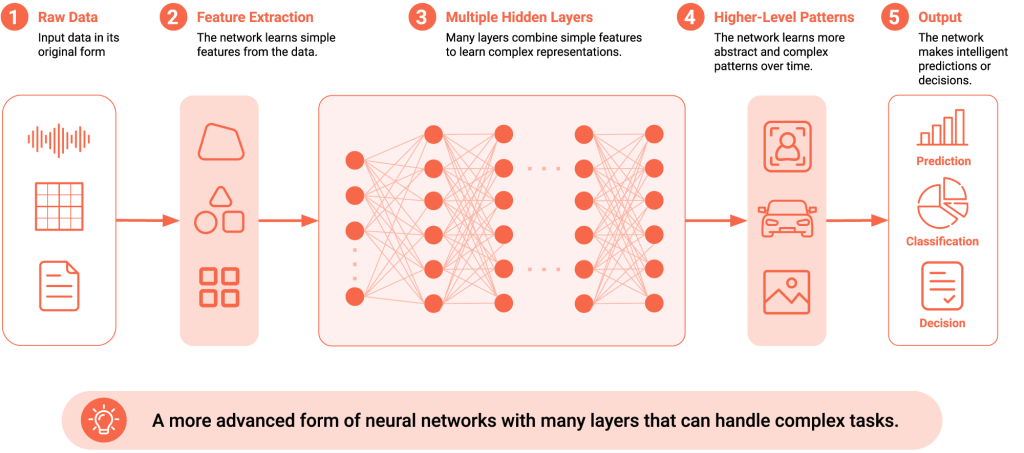
When many neural networks are stacked on top of each other, it results in a technique called deep learning, which was named more for the depth of the stack than anything more profound. Each layer learns slightly more abstract patterns than the one below it.
In a vision model, the first layers detect edges, the middle layers detect shapes, and the top layers detect whole objects like faces or cars. It has a similar recipe for language. The lower layers learn spelling and grammar, while higher layers learn meaning and context. But these neural networks for language still read sentences the way humans do, one word at a time, and struggle to remember the start of a long paragraph by the time they reach the end. Until 2017.
In 2017, a Google team published a paper titled “Attention Is All You Need,” introducing the transformer architecture. The transformer’s game-changing innovation is called “attention.” This lets the model look at every word in the input simultaneously and decide which words matter for understanding any other word.
The practical consequences of attention were significant: transformers performed markedly better on long, context-dependent text, and their parallel processing made training dramatically faster.
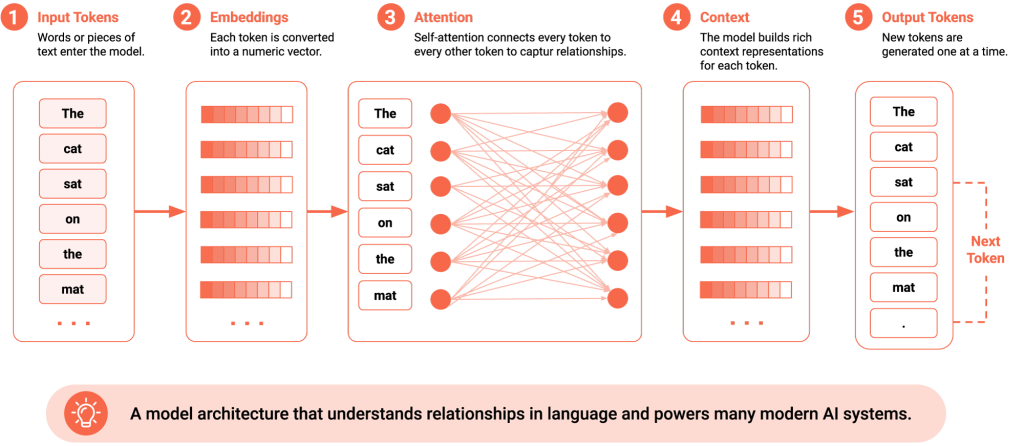
Every major language model in use today — GPT, Claude, Gemini, Llama — has the transformer architecture as its “brain.”
The systems described in the Predictive Era are, in the main, making a judgment: they assess inputs and render judgments. Is this a cat or not? Will this user convert? Should this bid be submitted?
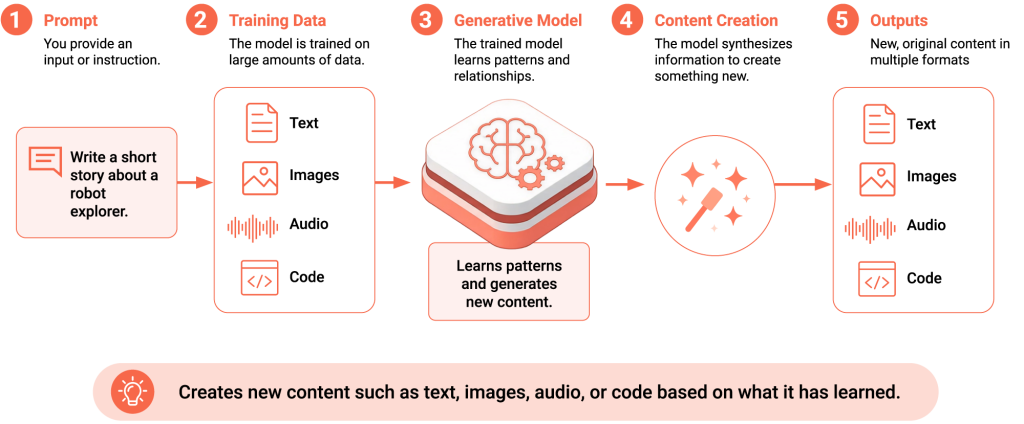
Generative AI does something completely different. It makes something that didn’t exist before. This leapt into public consciousness, and as it has evolved, we enter an entirely new era.
The Agentic Era: From Automation to Autonomy
The current frontier of AI development is characterized by a shift from task-level automation to goal-level autonomy. Agentic AI systems do not simply execute predefined functions; they reason about objectives, plan sequences of actions, adapt based on environmental feedback, and operate across tools and contexts with limited human intervention.
For the advertising industry, the implications are substantive across several domains.
In brand safety and suitability, the existing paradigm of keyword blocklists and binary scores is ill-suited to the contextual complexity of modern content environments. An agentic system can evaluate the full semantic context of a webpage, video, or social post and apply nuanced, brand-specific suitability criteria. It can also update those criteria in real time as news cycles and cultural conditions shift. The judgment involved is qualitative in ways that rule-based systems cannot replicate.
In media buying and campaign optimization, agentic AI extends the efficiency gains that programmatic systems have delivered over the past two decades. Real-time decisioning systems already adjust bids based on predicted conversion likelihood.
Agentic systems go further. They can set and adapt media plans around the strategic objectives of reach, engagement, ROAS, incremental lift without human intervention.
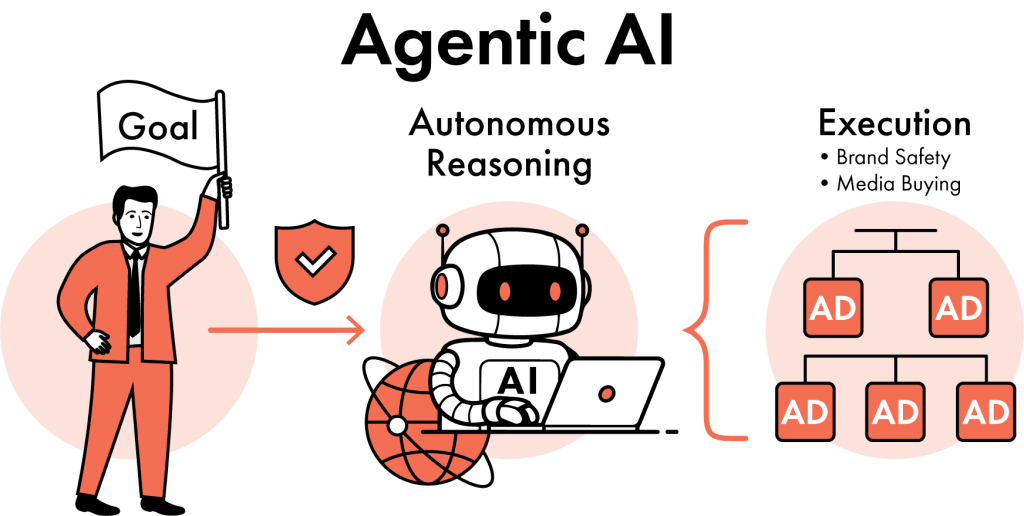
They can shift budget dynamically across channels as performance conditions change, generate and deploy creative variants autonomously, and coordinate messaging across walled gardens, open web, and retail media networks while optimizing toward unified KPIs.
The transition the industry is undergoing is, in aggregate, a shift from programmatic automation — machines executing human-defined rules faster and at greater scale — to strategic autonomy, machines reasoning toward human-defined objectives with minimal human intervention in the execution. That is a meaningful change in the nature of the relationship between human judgment and machine action. But not one we should enter into blindly.
What This History Reminds Us
The arc from Turing’s 1950 paper to today’s agentic systems is not a story of sudden disruption. It is a story of cumulative technical progress, punctuated by genuine breakthroughs, built on decades of investment in data infrastructure, compute hardware, and foundational research. Advertising has been one of the most important environments in which that progress has been tested and deployed at scale.
To realize the full benefits of agentic at scale, we need standards and clear governance for these new capabilities. Without them how do we foster agentic reliability and interoperability, mitigate hallucinations in ad operations, or worse, media buying, and ensure a campaign is properly trafficked via an agent?
Just as the pioneers of AI unlocked breakthroughs by building on past foundations, our path to autonomous media workflows relies on the infrastructure we have already built. The agentic future does not demand a costly engineering reset; it requires us to anchor next-generation AI reasoning within our industry’s battle-tested, open-source standards.
IAB Tech Lab’s work exists precisely to create that shared understanding and to translate it into standards and frameworks the industry can rely on. The machines are making more decisions, more autonomously, with greater consequences. The obligation to understand them, and give them rails to follow, has never been greater.

Barnaby Edwards
Sr Director, Product Marketing
IAB Tech Lab